
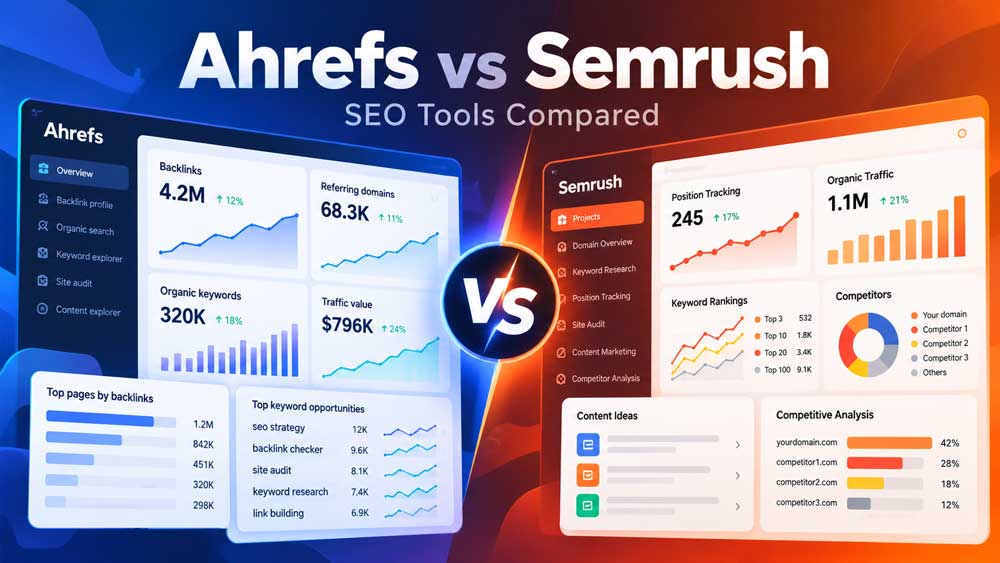
Choosing between Ahrefs and Semrush comes down to the SEO work you do most often. Both platforms offer keyword research, competitor analysis, backlink data, rank tracking, and site auditing—but their strengths, workflows, and plan limits differ. This guide compares the tools by practical use case and explains how to evaluate pricing without relying on outdated plan figures.
Quick verdict: Ahrefs vs Semrush
Choose Ahrefs If…
- Backlink research and link prospecting are central to your strategy.
- You want to explore competitor pages and the keywords behind their organic traffic.
- Your team prefers a focused SEO research workflow.
Choose Ahrefs If…
- You want a broader marketing toolkit alongside SEO.
- Your workflow combines SEO, paid search, content planning, and competitor research.
- You value campaign-oriented reporting and a wide range of integrated tools.
Neither platform automatically produces better rankings. Results depend on the quality of your research, technical fixes, content, links, and how consistently your team acts on the data.
Ahrefs vs Semrush at a glance
| Area | Ahrefs | Semrush |
|---|---|---|
| Keyword research | Strong keyword exploration and SERP analysis | Strong keyword research with broader campaign tooling |
| Backlink analysis | A core strength; useful for link discovery and competitor link profiles | Comprehensive backlink analysis and link-building workflows |
| Technical SEO | Site auditing and issue discovery | Site auditing with a broad set of connected marketing tools |
| Rank tracking | Organic position monitoring | Position tracking with campaign and reporting features |
| Content workflow | Research-led content and competitor analysis | Content planning and optimization tools integrated into a wider suite |
| Wider marketing | Primarily SEO-focused, with adjacent tools | Broader SEO, PPC, content, and competitive marketing toolkit |
| Best fit | SEO specialists, link builders, research-heavy teams | Agencies and teams managing several digital marketing channels |
1. Keyword research
Both platforms help you discover search terms, estimate demand, inspect search results, and identify competitor opportunities. Use either to build topic clusters, compare keyword difficulty, and find queries that match the intent of your audience.
Where Ahrefs stands out
Ahrefs is especially useful when keyword research is tied closely to competitor pages and organic search analysis. You can investigate which pages attract search traffic, explore the terms associated with those pages, and use that evidence to prioritize content opportunities.
Where Semrush stands out
Semrush connects keyword research with a larger campaign workflow. That can be convenient when the same team manages SEO, paid search, content calendars, and reporting, and wants research to feed into multiple marketing activities.
Practical Test: Run the same five target topics through both tools. Compare keyword ideas, local database coverage, intent signals, SERP features, and how easily you can turn the findings into a brief. Data availability can vary by country and search engine.
2. Backlink analysis and link building
Both platforms help you discover search terms, estimate demand, inspect search results, and identify competitor opportunities. Use either to build topic clusters, compare keyword difficulty, and find queries that match the intent of your audience.
Backlink data helps you understand who links to your site, which competitor pages attract links, and where relevant outreach opportunities may exist. Ahrefs has a particularly strong reputation for backlink research, making it a natural fit for link-focused SEO teams.
Semrush also offers backlink analytics and link-building workflows. It may be the more convenient choice when outreach and link analysis need to sit alongside other campaign tools and reports.
- Review referring domains and the quality and relevance of linking sites—not just raw backlink counts.
- Study competitor pages that earn links and identify a genuinely useful asset you could create.
- Treat authority metrics as third-party estimates, not Google ranking factors or guarantees.
3. Site audits and technical SEO
A site audit can flag crawlability problems, broken links, metadata issues, redirect problems, and other technical concerns. Both products can help teams find and prioritize issues, but audit scores are diagnostic aids—not a direct measure of Google rankings.
The best choice depends on how clearly each tool explains an issue, how well its recommendations fit your site, and whether your team can verify and fix the problem. Always validate high-impact findings with a crawl, browser checks, server logs, and Google Search Console where appropriate.
4. Rank tracking and competitor analysis
Rank tracking helps you monitor visibility over time, while competitor analysis shows where other sites overlap with or outperform you. Compare location and device settings carefully: rankings vary by market, search context, and measurement method.
Semrush may appeal to teams that want rank tracking closely tied to campaign reporting. Ahrefs suits teams that prefer to move from competitor discovery into page-level organic research. For either tool, focus on trends, landing-page performance, and business outcomes rather than reacting to every daily ranking change.
5. Content research and optimization
Both tools can support content planning by revealing search demand, competing pages, related topics, and gaps in your existing coverage. Semrush offers a wider set of content marketing features in its broader platform; Ahrefs is useful for research-driven planning based on competitors and organic search data.
- Start with search intent and the reader’s task, not a keyword list alone.
- Analyze the pages already ranking and identify what they answer well—and what they miss.
- Create original, useful content with clear examples, credible sources, and a sensible internal-link structure.
- Revisit performance after publication using Search Console and analytics, then update based on evidence.
6. Pricing: how to compare the real cost
Ahrefs and Semrush use tiered plans, and the total cost depends on more than the headline monthly price. Plan names, included limits, add-ons, billing terms, and promotional offers can change, so confirm current figures on each vendor’s official pricing page before purchasing.
What to check before choosing a plan
- Tracked keywords and the frequency of rank updates.
- Projects, websites, users, and client accounts included.
- Monthly limits for reports, keyword rows, crawls, and historical data.
- Content, local SEO, reporting, and competitive research features included versus sold separately.
- Monthly versus annual billing, trial conditions, and cancellation terms.
Budget Tip: Estimate the cost per active project or client, then map the limits to your team’s actual weekly workflow. A cheaper entry plan can become expensive if you need add-ons or regularly hit report limits. Check the official pages: Ahrefs pricing and Semrush pricing.
7. Which tool has better SEO performance?
There is no universal winner for SEO performance. These platforms provide estimates and workflows; they do not control Google’s algorithm or guarantee rankings. Their databases, refresh schedules, and metrics can differ, so estimates from the two products should not be treated as directly interchangeable.
To evaluate them fairly, choose a small set of known keywords and competitor pages from your target market. Compare coverage, data freshness, the usefulness of recommendations, reporting effort, and whether the insights lead to measurable improvements in organic clicks, qualified visits, leads, or revenue.
8. Which is best for your team?

Freelancers and solo SEO consultants
Choose the platform whose core research features fit your most common client work and whose plan limits comfortably cover your active projects. If link research dominates your work, start by testing Ahrefs. If you need SEO plus paid-search and broader marketing workflows, test Semrush.
Agencies
Agencies should prioritize client separation, reporting, seats, project limits, and the time required to produce repeatable audits and updates. Trial the exact reporting workflow you plan to sell before committing to a larger subscription.
In-house SEO teams
In-house teams should consider the size of the site, technical complexity, number of markets, collaboration needs, and integrations with existing analytics and reporting. Run a short pilot with real tasks instead of choosing based on feature count alone.
Our Final Say
Ahrefs is a strong choice for SEO professionals who prioritize backlink intelligence, competitor research, and organic search analysis. Semrush is a strong choice for teams that want SEO within a broader digital marketing platform. Both can support an effective SEO program; the better option is the one that provides reliable enough data for your market, fits your workflow, and helps your team take action.
Frequently Asked Questions
Not for every team. Ahrefs is often favored for backlink and organic research, while Semrush offers a broader marketing toolkit. Compare them against your actual tasks and target markets.
It can be worthwhile if your team uses its SEO, content, competitive, and paid-search features regularly. Check the current plan limits and calculate the cost against the time and tools it replaces.
Yes. Some teams use one platform as their primary tool and the other for a second opinion on backlink, keyword, or competitor data. Avoid paying for overlapping features unless the extra insight justifies the cost.
No. They provide data and recommendations, but rankings depend on many factors, including relevance, content quality, technical accessibility, competition, and links. Use them to inform decisions and measure results with first-party analytics.
