
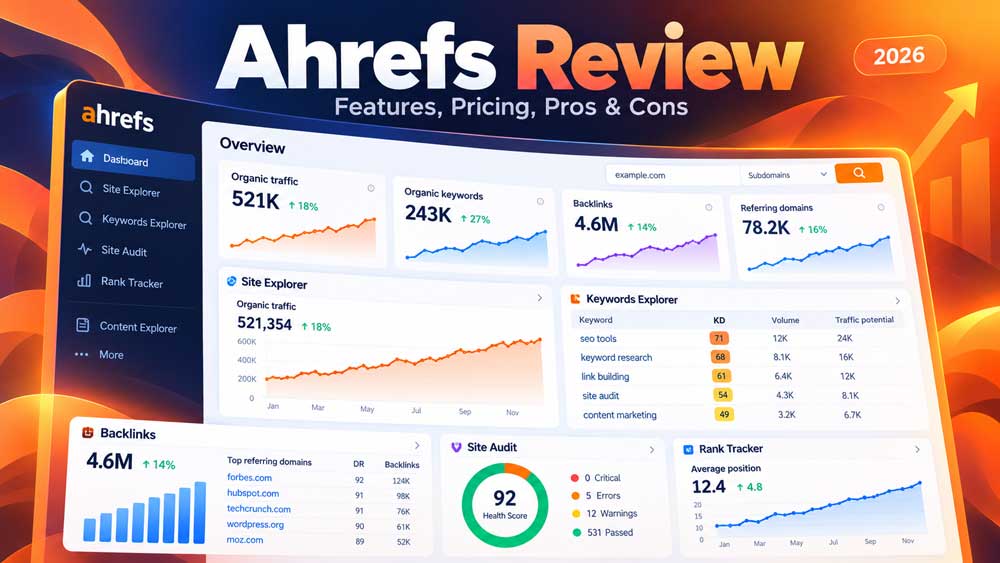
SEO TOOL REVIEW · 2026
Ahrefs is a comprehensive SEO research platform designed to help teams understand organic search, backlinks, competitors, website health, and rankings. Its greatest appeal is the ability to move from a competing website to its ranking pages, keywords, referring domains, and technical signals without juggling several unrelated research tools. That breadth does not automatically make it the right purchase for every team: the plan limits, subscription price, and amount of research you conduct are important parts of the decision.
In this Ahrefs review, we examine what the platform offers in 2026, which workflows justify paying for it, where it has limitations, and how to evaluate the plans. We also explain the difference between Ahrefs’ third-party SEO estimates and first-party data from your own analytics or Google Search Console.
At a glance
Best suited to: Search-focused teams that frequently research competitors, keywords and backlinks.
Consider: Recurring subscription cost, allowances and data-export needs.
Editorial methodology: This review is based on Ahrefs’ published product documentation, pricing information, and a workflow-based evaluation framework checked on October 22, 2026. It is not presented as a hands-on benchmark or a claim that Rival Ratings independently tested a paid Ahrefs account. Pricing and features may change; confirm current terms before purchasing.
Quick verdict: Is Ahrefs worth it?
Ahrefs is worth considering if organic search is an important acquisition channel and you regularly research competitor pages, discover keyword opportunities, investigate backlinks, or audit sites. For an SEO specialist or agency, the value lies in using those reports to make faster, better documented decisions. For a small business owner checking rankings a few times a month, a paid plan may be harder to justify.
Best for
Best fit: SEO consultants, content strategists, link-building specialists, in-house SEO teams, and agencies that make frequent research decisions.
Consider alternatives
Consider alternatives if: you mainly need basic visibility for your own website, want an all-in-one paid-advertising suite, or have a budget that cannot support recurring subscriptions.
Test before buying
What to test: keyword coverage for your geography, usefulness of backlink reports, export needs, tracked-keyword limits, site crawl allowances, and how many people need access.
If you are also evaluating Semrush, read our Ahrefs vs Semrush comparison for a workflow-based look at the two competing platforms.
Ahrefs at a glance
| Area | What you should know |
|---|---|
| Category | SEO research, competitive analysis, rank monitoring, and website auditing |
| Core products | Site Explorer, Keywords Explorer, Site Audit, Rank Tracker, plus plan-dependent research and reporting features |
| Free access | Ahrefs Free offers limited access for verified websites |
| Entry paid access | Starter plan, subject to usage and report limitations |
| Best purchasing question | Will recurring SEO decisions justify the subscription and any usage costs? |
| Not a substitute for | Google Search Console, first-party analytics, editorial judgment, or technical validation |
What is Ahrefs, and how does it work?
Ahrefs maintains large search and link datasets and presents them through research tools. You can enter your own domain, a competitor’s domain, a specific URL, or a keyword to explore patterns in organic visibility. Researchers use these estimates to identify possible opportunities, prioritize work, and compare sites at scale.
That distinction matters: a traffic estimate in Ahrefs is not a reading from another site’s private analytics account. Likewise, its keyword difficulty and authority-style metrics are proprietary models. They are useful signals, not definitive statements about Google’s ranking decisions or a guarantee that your page will rank.
A good Ahrefs workflow combines its competitive research with Google Search Console for the actual clicks and impressions of websites you control. When reported numbers disagree, check geography, device, time window, and metric definitions before concluding that either tool is broken.
Key Ahrefs features reviewed
1. Site Explorer: competitor pages, organic traffic estimates, and backlinks
Site Explorer is central to Ahrefs’ competitive-research workflow. You can investigate a domain’s organic keywords, top pages, linking domains, and competing search properties. According to the official Site Explorer training, the tool can examine a domain, subdomain, subfolder, or exact URL, which is useful when a competitor has many products or content sections.
Practical use case: Imagine your company sells scheduling software. Instead of copying the entire content calendar of a large competitor, narrow your research to the competitor’s scheduling-related pages. Look for pages that attract relevant search demand, determine what user question they answer, and identify where your own expertise can provide a more useful answer.
Limitations: Reported traffic and link counts are based on Ahrefs’ collected data and models. Some links and keywords may not appear, and competitors can have traffic that SEO tools cannot observe. Check samples rather than treating a single estimate as an exact measurement.
2. Keywords Explorer: opportunities, intent, and SERP analysis
Keywords Explorer supports keyword discovery and analysis using volume estimates, difficulty signals, related terms, and search-results context. Rather than selecting the largest-volume term, a useful workflow begins with a customer’s task and checks the actual results pages to see which format Google currently rewards.
Ahrefs explains that its Traffic Potential metric estimates traffic to a top-ranking page from multiple queries, while keyword difficulty is only one part of assessing competitiveness. For a content publisher, that distinction helps avoid creating several shallow pages targeting variations of the same need.
Practical use case: Start with a seed term such as “project management software for architects.” Review the search-intent mix, nearby questions, currently ranking pages, and whether a detailed comparison or a how-to guide would answer the query better.
Limitations: Search volume and difficulty are estimates; values and update schedules vary by query and geography. According to Ahrefs’ data-refresh explanation, popular results may refresh more frequently than lower-volume queries.
3. Backlink analysis and link opportunities
Link analysis is one of the principal reasons SEO professionals consider Ahrefs. Examining referring domains, links to competing pages, and the content that naturally attracts citations can reveal editorial opportunities. An insightful research task is not merely to count links, but to discover why a specific resource earns them: proprietary research, statistics, a useful calculator, or an unusually clear reference guide.
Practical use case: Identify several relevant publications that linked to a competitor’s industry survey. Check whether your business can produce a genuinely useful updated analysis before approaching those sites. Avoid sending generic requests for links without a compelling reason to cite your work.
Limitations: A high backlink count does not automatically mean high link quality. Evaluate relevance, editorial context, and the target page; avoid confusing third-party link metrics with Google’s own assessment of quality.
4. Site Audit: technical SEO problems and prioritization
Site Audit crawls website pages to find technical issues that warrant review, such as linking problems, indexability signals, duplicates, or other crawl-related defects. This can be helpful across a large site because recurring patterns are difficult to find manually.
Practical use case: After a migration, crawl important templates and investigate unexpected redirects, broken resources, canonical changes, and pages that are no longer reachable through navigation. Prioritize problems affecting valuable pages and confirm fixes by recrawling.
Limitations: A clean score does not prove that the content satisfies readers or will rank. Site Audit can also be affected by crawling restrictions or JavaScript settings, as Ahrefs discusses in its crawl troubleshooting documentation.
5. Rank Tracker: monitor visibility over time
Rank Tracker follows specified keywords over time, including desktop and mobile views and location-based segmentation. Its most helpful role is to establish a consistent trend rather than to make you react to every position change. Ahrefs’ Rank Tracker overview explains how rankings can be viewed by location, tags, and device.
Practical use case: Group tracked keywords by service line or content cluster, then compare movement with actual clicks and conversions. If rankings rise but inquiries do not, the problem may be intent or page experience rather than a need for more keywords.
Limitations: Rankings vary with location, device, search features, and timing. Ahrefs’ current plan comparison lists weekly rank updates in the main plans; check any optional updates or additional limits before buying.
6. Content Explorer, reporting, and AI visibility
Beyond its core research tools, Ahrefs offers additional content discovery, reporting, and AI-visibility functionality that varies by plan. For example, Ahrefs’ official plan documentation distinguishes Content Explorer availability on Standard and higher plans from entry-level access.
Ahrefs also offers Brand Radar for research into brand appearances in AI-generated answers. This is a changing and separately priced area; do not assume that paying for an ordinary SEO plan includes every AI visibility dataset or monitoring feature. Read the entitlement and usage details before treating it as part of a package.
Ahrefs pricing in 2026: which plan makes sense?
The following are publicly advertised U.S.-dollar monthly starting prices viewed October 22, 2026, not a personalized quote. Ahrefs may change plans, regional billing, add-ons, and limits. Always confirm the official pricing page before subscribing.
| Plan | Advertised monthly starting price | Most plausible fit |
|---|---|---|
| Ahrefs Free | Free | Owners checking limited data on verified properties |
| Starter | $29 | Occasional research and beginners working within stricter limits |
| Lite | $129 | Solo operators with recurring keyword and competitor research needs |
| Standard | $249 | Consultants and active SEO specialists requiring more reports and data |
| Advanced | $449 | Growing teams managing more projects and larger research workflows |
| Enterprise | From $1,499; annual commitment required | Organizations requiring enterprise-scale controls and support |
The headline rate is only a starting point. Plan capabilities can differ by number of unverified projects, keyword tracking allowances, crawl credits, history, export rows, API use, and included seats. Ahrefs’ Starter documentation notes the plan’s credit-based limitations and single-user orientation. The current usage policy distinguishes credit-based Starter/Lite from the fair-use approach on current Standard-and-higher plans.
Our buying approach: Calculate your expected monthly research tasks before selecting a tier. Count active projects, people, tracked keywords, how often you need exports, and how many technical pages you may crawl. A cheaper plan can become frustrating if normal work repeatedly hits limits; an expensive one is wasteful if you only log in occasionally.
Ahrefs advantages: what the platform does well
- Connected SEO research workflow: Organic pages, competitors, keywords, and backlinks can be investigated in a common research environment.
- Useful competitive context: Site Explorer helps researchers examine individual pages and sections rather than only whole domains.
- Multiple angles on search demand: Keyword estimates, search-results context, and traffic-potential modeling encourage more nuanced topic decisions than raw search volume alone.
- Technical and ongoing monitoring: Site Audit and Rank Tracker help teams connect discovery with recurring checks.
- Plan range: Free and Starter access can make sense for narrow use cases, while higher tiers support more demanding research.
These are strengths suggested by product capabilities and documented workflows; they are not findings from our own controlled product-performance benchmark.
Ahrefs disadvantages: what buyers should consider
- Price can be substantial: The main paid plans may be expensive for a small company with infrequent research requirements.
- Usage and seat limits need attention: Credits, tracking allowances, exports, crawling, and extra-user costs can materially affect your bill and workflow.
- Estimates have uncertainty: Organic traffic, link coverage, keyword difficulty, and traffic potential are third-party calculations, not complete or exact measurements.
- Learning effort: A large number of reports can distract a team that has not defined its SEO questions and processes.
- Not an entire marketing stack: Businesses needing campaign-heavy PPC management, broader marketing automation, or CRM functions may still need complementary software.
Ahrefs for different users: who should choose it?
Solo creators and small business owners
Start by asking whether you need competitive research every week or only occasional checks on your own domain. If your priority is identifying indexing errors, understanding your actual clicks, and making a few basic site fixes, first-party free tools plus Ahrefs Free may cover much of the immediate need. Move to Starter or Lite when competitor and keyword research becomes a recurring, justified workflow.
Freelancers and SEO consultants
Freelancers preparing content strategies, link audits, and competitor reports regularly may value the connected data enough to justify a paid plan. Test how quickly you can turn research into client-ready recommendations, and scrutinize exports, projects, and seat needs before committing.
In-house marketing teams
In-house teams should compare the value of deep organic research against the need for other marketing channels. If one platform is expected to cover paid ads, campaign orchestration, and multi-channel reports as well as SEO, the best answer may involve another tool or a combination of products.
Agencies and large organizations
Agencies should model client volume, user permissions, reporting schedules, API requirements, and access to historical data. Enterprise requirements such as single sign-on, administration, and contract terms belong in procurement review, not as afterthoughts.
How Ahrefs compares with Semrush
The fundamental difference is not that one product can “do SEO” and the other cannot. Both provide keyword research, technical auditing, competitive analysis, and rank tracking. Ahrefs is a natural candidate for research-heavy teams prioritizing organic search, competitive pages, and backlinks. Semrush may suit organizations seeking broader connected marketing workflows in one vendor environment; see our Semrush review for more on those features and its plan options. This is a fit-based distinction, not a claim that one produces better rankings.
Our dedicated Ahrefs vs Semrush: Features, Pricing & SEO Performance Compared article covers that decision side by side. The other product’s pricing and plan coverage should be checked separately before selecting a winner.
A practical checklist before subscribing to Ahrefs
- Define the job: List the five SEO questions you most need answered each month.
- Test relevant geography: Check whether the keyword and competitor data is useful for your target locations and languages.
- Audit limits: Estimate tracked keywords, crawl credits, exports, API access, projects, and users for the coming six months.
- Confirm source quality: Independently spot-check meaningful estimates rather than using vendor metrics as exact facts.
- Plan for action: Assign an owner to convert reports into content improvements, technical fixes, and measurable business outcomes.
- Review purchase terms: Confirm billing cycle, cancellation rules, overage options, and any add-ons using current official terms.
Frequently asked questions about Ahrefs
It can be, particularly when a beginner has a defined project and follows a clear learning path. Start with limited-access options and master the difference between keyword estimates, site health issues, and actual search performance before buying a more expensive plan.
Yes. Ahrefs Free provides limited functionality for websites you verify. It is not equivalent to full competitor research on a paid plan.
It is a research platform that publishes modeled SEO metrics. Accuracy differs by report, query, location, and freshness of collected data. Cross-check important conclusions against source pages, live search results, and first-party data where available.
No. Ahrefs identifies information and potential issues; outcomes depend on your implementation, content quality, technical accessibility, competition, and other factors.
No. The tools have different roles. Search Console reports Google’s own performance and indexing data for a verified property; Ahrefs is especially useful for broader competitive discovery and modeled SEO research.
There is no universal winner. Ahrefs may be the more natural choice for a research-first SEO workflow; Semrush may appeal to teams that want more of their digital marketing workflow in a single suite. Read our linked comparison and trial the specific tasks that matter to your team.
Our Final Say
Ahrefs is a serious option for people who need to make frequent, informed SEO decisions. Its Site Explorer, keyword and link research, auditing, and rank monitoring provide a structured way to investigate search opportunities and problems. Its biggest trade-off is the combination of subscription cost, plan limits, and the expertise required to turn reports into outcomes.
Our recommendation: Start with a written list of recurring SEO questions and match the lowest plan that can answer them reliably. If your work is primarily organic competitor research and backlinks, put Ahrefs on the shortlist. If you require a wider marketing suite or have infrequent needs, compare alternatives carefully before subscribing.
For the next step, see Ahrefs vs Semrush: the full comparison.
Sources and disclosure
- Ahrefs official pricing and limits — consulted October 22, 2026.
- Ahrefs Starter plan help article — features and usage limits.
- Ahrefs Site Explorer training — product workflow and scope.
- Ahrefs Rank Tracker training — device and location views.
- Ahrefs Brand Radar — separately scoped AI visibility functionality.
Disclosure: This article is an independently prepared, source-based editorial assessment. It does not claim hands-on testing, verified ranking gains, or a paid endorsement. If affiliate links are added later, the relationship should be disclosed clearly at the relevant links.
