SEO TOOL REVIEW · 2026
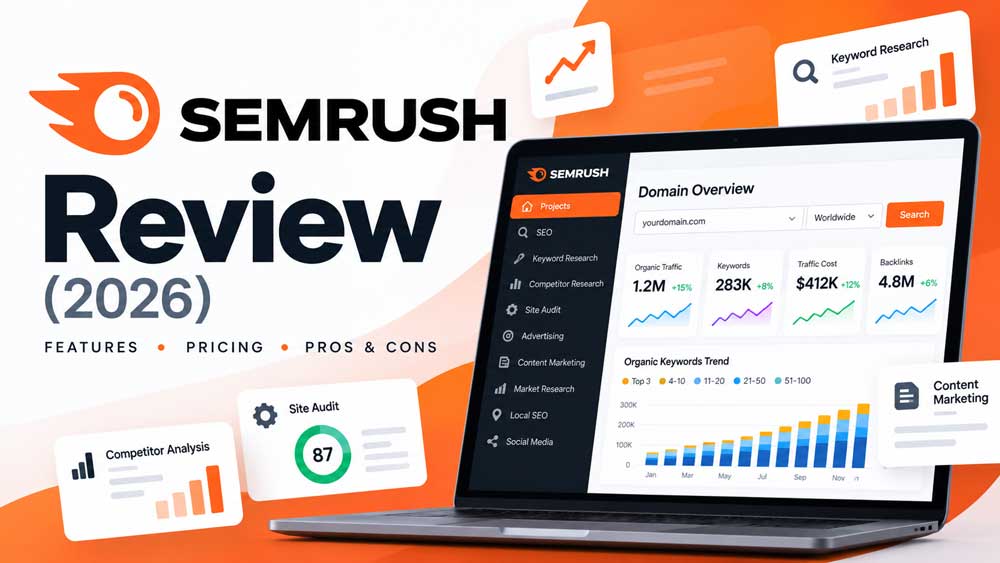
Semrush is a digital marketing research platform best known for keyword research, competitor analysis, position tracking, and technical SEO. Its current subscriptions also span AI-search visibility and optional specialist toolkits, making it important to distinguish the core SEO product from the broader package.
This review explains what Semrush does, where it may fit your workflow, how its pricing is structured, and which limitations should influence a buying decision. It is intended for search professionals, marketers, founders, agencies, and anyone comparing Semrush with Ahrefs.
At a glance
Best for: SEO specialists, content teams and agencies managing several research and monitoring workflows.
Key consideration: The difference between SEO Classic, Semrush One, optional toolkits and extra-user charges.
Editorial methodology: This is a source-based assessment of Semrush’s published capabilities, documentation and pricing as reviewed October 23, 2026. Rival Ratings has not conducted a controlled hands-on trial of a paid Semrush subscription. Product numbers, prices and plan entitlements can change. We distinguish vendor claims from our interpretation and encourage readers to confirm them before purchasing.
Quick verdict: Is Semrush worth it?
Semrush is worth considering when your work combines ongoing SEO research, competitive intelligence, site auditing and reporting. Teams evaluating search visibility across traditional and AI search can consider Semrush One, while buyers who primarily need established SEO tools should compare its SEO Classic packages. Its range of tools is useful only when your team has a clear plan to use them; a large feature catalog by itself does not justify a high subscription cost.
Choose Semrush if…
- You manage multiple content, keyword and competitor-analysis workflows.
- You need structured daily position tracking and recurring technical audits.
- You value connected reporting and are willing to compare plan limits carefully.
Consider alternatives if…
- Your main use case is occasional checking of a single website.
- You primarily want specialized backlink research or a narrower organic-search interface.
- The subscription and extra-toolkit costs exceed your expected use.
Verify before buying
- Which toolkit or bundle includes each feature you will use.
- Tracked-keyword, project, site-crawl and reporting limits.
- Local database coverage, permissions, user seats and renewal terms.
Semrush at a glance
| Area | Assessment |
|---|---|
| Primary role | Organic search research, technical SEO and competitor monitoring |
| Representative tools | Keyword Magic Tool, Domain/Keyword Overview, Position Tracking, Site Audit, Backlink Analytics |
| Subscription options | SEO Classic (Pro, Guru, Business); Semrush One (Starter, Pro+, Advanced); other toolkits |
| Key strength | Multiple connected workflows for keyword research, monitoring and reporting |
| Main trade-off | Cost, plan complexity, tool-specific limits and learning effort |
| Editorial basis | Officially documented capabilities; not an independently executed product test |
What is Semrush and how does it work?
Semrush organizes research around keywords, websites and projects. Competitive tools estimate how domains perform in organic search, while project-based tools track selected queries and crawl sites you want to monitor. These outputs can help a team identify subjects to cover, inspect a competitor’s visibility, discover technical problems and communicate changes to clients or managers.
According to Semrush’s official SEO Toolkit overview, its research tools span keyword discovery, backlink analysis, rank tracking and site auditing. A typical workflow starts with a competitor’s domain, moves into keyword opportunities, tests actual search results, and then establishes ongoing tracking for the pages you own.
A critical distinction: estimates of another site’s traffic, ranking difficulty or link strength are modeled data. They are not the same as that site’s private Google Analytics or Search Console measurements. Treat them as decision support and verify important conclusions with live pages and first-party data whenever possible.
Key Semrush features reviewed
1. Keyword Magic Tool and keyword research
Semrush’s Keyword Magic Tool expands a seed phrase into related terms, questions and keyword variations. Research views can help you sort ideas by search demand, estimated competitiveness and search-results features. This is valuable for content teams building a coherent group of pages, not simply chasing whichever keyword has the largest number.
How to evaluate it: Enter a topic relevant to your audience—for instance, CRM software for small clinics. Check whether suggested phrases describe genuinely distinct reader needs. Group related queries by search intent, inspect the live results and compare the usefulness of the ideas in your target country.
Limitations: Search demand and difficulty are estimates that depend on database coverage and update cadence. Free usage and exports are restricted, and additional research capabilities can depend on the subscribed toolkit.
2. Domain and competitor analysis
Domain Overview and organic competitor reports help marketers investigate a competitor’s estimated visibility, high-performing pages and ranking keywords. Comparing several similar businesses can show which topic clusters appear well covered and where your own site lacks useful material.
How to evaluate it: Choose two real competitors in the same country and industry. Review their strongest relevant pages, then cross-check a sample in actual search results. Use findings to plan original content that serves the same user need more effectively—not to reproduce competitor copy.
Limitations: Estimated visits and visibility indicators can differ from actual traffic; especially with smaller websites, a single data point should not drive a large investment.
3. Position Tracking and local targeting
Semrush’s Position Tracking monitors selected keywords over time. The official documentation describes daily rank monitoring, configurable locations and devices, and competitor comparisons. The SEO Classic Pro plan currently lists 500 tracked keywords; Guru lists 1,500 and Business 5,000.
How to evaluate it: Set a consistent search engine, device, location and query list. Compare weekly movement to page changes and actual clicks. For a location-dependent service, check whether the geographic targeting represents where customers search.
Limitations: Google results vary by location, device, SERP features and date. Adding more tracked markets or devices consumes allowances; multitargeting depends on plan. A ranking increase is not necessarily an increase in leads.
4. Site Audit and on-page SEO checks
Site Audit crawls pages to flag technical issues such as broken links, redirect problems, canonical signals, crawl restrictions and certain structured-data or performance concerns. Semrush’s documentation describes more than 140 on-page and technical checks, with customization for crawl scope and JavaScript rendering.
How to evaluate it: Crawl a staging site or a controlled section of your website. Verify a few high-severity results manually, then fix and recrawl them. Prioritize issues affecting useful pages instead of trying to eliminate every warning immediately.
Limitations: Crawler access and settings influence the findings. Automated health scores do not directly measure search rankings, and a technically clean page can still fail to answer a user’s question.
5. Backlink Analytics and backlink auditing
Backlink Analytics explores linking domains and pages to understand how websites attract mentions and references. Semrush also documents a Backlink Audit workflow for investigating suspicious links and analyzing lost or new links.
How to evaluate it: Review a sample of links to a competitor’s genuinely useful resource. Inspect relevance, editorial context, and the source page rather than treating raw counts as a quality rating. Look for assets your own team could contribute to the topic.
Limitations: All commercial link indexes have coverage differences. A vendor’s ‘toxicity’ metric alone is not a reason to disavow links; broad disavow decisions need careful validation under Google’s guidance.
6. Content tools, reports, and AI-search visibility
Semrush’s higher-tier SEO plans add historical research and selected content optimization capabilities. Separately, Semrush One combines SEO and AI visibility features, including domain-level AI brand reporting and prompt monitoring. These product boundaries matter because the base SEO Classic plan should not be assumed to include every content or AI measurement feature.
How to evaluate it: List your desired monthly reports and questions about AI-search visibility. Decide whether these are core business requirements or interesting secondary dashboards. Confirm how many prompts, projects, domains and reports your chosen package covers.
Limitations: Brand mentions in generated answers vary across prompts and time. AI visibility measures are an emerging reporting category, not a guarantee that a business will receive referrals or leads.
Semrush pricing in 2026: SEO Classic vs Semrush One
Semrush’s pricing is easy to misread because the SEO Classic plans and the newer Semrush One bundles are distinct offerings. The prices below are the publicly advertised approximate monthly rates in U.S. dollars, checked October 23, 2026. Depending on the official pricing interface, figures may display rounded whole dollars or amounts ending in .95. Taxes, regional pricing, annual billing, limited-time offers, add-ons and extra seats can change the total.
SEO Classic: SEO research without the full AI visibility bundle
| SEO Classic plan | Approx. monthly price | Published monitoring allowance | Best initial fit |
|---|---|---|---|
| Pro | Around $139–$140 | 5 projects; 500 tracked keywords | Independent practitioners and small sites |
| Guru | Around $249–$250 | 15 projects; 1,500 tracked keywords | Growing teams needing historical data |
| Business | Around $499–$500 | 40 projects; 5,000 tracked keywords | Agencies and larger monitoring workloads |
Semrush’s SEO Classic pricing page outlines the core tiers; its help-center comparison provides additional usage limits. Guru adds selected historical data and content capabilities; Business increases tracking, crawling and report allowances and introduces certain API capabilities.
Semrush One: SEO plus AI-search visibility
| Semrush One plan | Advertised monthly price | Traditional keywords / AI prompts daily | Positioning |
|---|---|---|---|
| Starter | $199 | 500 keywords / 50 prompts | Small teams beginning SEO and AI monitoring |
| Pro+ | $299 | 1,500 keywords / 100 prompts | Growing teams needing extra projects, history and multitargeting |
| Advanced | $549 | 5,000 keywords / 200 prompts | Larger workloads and expanded data access |
These Semrush One figures appear in the official Semrush One pricing information; the October 21, 2026 Starter vs Pro+ comparison also explains the differences between its first two levels. Semrush One packages SEO and AI-search monitoring; they are not merely renamed versions of SEO Classic.
How to choose: If you mainly research Google rankings and competitor pages, start by evaluating SEO Classic. If tracking how your brand appears in AI-generated responses is part of your reporting obligations, evaluate the corresponding Semrush One tier. Do not pay for advanced prompt or history limits unless those capabilities have a real owner and business use.
Other costs and plan limitations to review
- Check add-on toolkits separately: advertising, local, content, social, and traffic-market intelligence may have independent fees or terms.
- Confirm whether additional user seats, branded reports, scheduling, API access and historical records are included.
- Model site crawl volume, keyword tracking and project limits for your actual number of clients or websites.
- Check whether you need one country and device or many; additional targets may use shared allowances.
- Compare monthly and annual commitments and document cancellation and renewal conditions.
Semrush’s published subscription details describe additional-user charges and toolkit-dependent pricing. Always verify the current plan FAQ before signing a contract. The least expensive tier is not necessarily the least expensive usable setup.
Semrush advantages
- Broad SEO workflow: Keyword, competitor, position and audit research are organized within one vendor ecosystem.
- Daily rank monitoring: Location- and device-specific tracking can support recurring reports.
- Site management: Project dashboards tie recurring website audits to monitored properties.
- Scalable plans: Buyers can compare the simpler SEO Classic line with AI visibility bundles.
- Useful collaboration potential: Reporting and extra-user options can suit teams managing more than one website.
Semrush disadvantages
- Plan complexity: Bundles, toolkit upgrades and add-ons make comparisons less straightforward.
- Ongoing cost: More substantial plans may be difficult to justify for occasional SEO checks.
- Modeled estimates: Traffic, search demand and competitor figures cannot substitute for first-party measurements.
- Learning effort: Teams can spend time exploring reports without a defined decision framework.
- Allowance constraints: Projects, tracked keywords, multiple targets and report limits can shape daily work.
These strengths and trade-offs are our source-based assessment of Semrush’s documented tools and pricing structure, not conclusions from controlled hands-on benchmarking. No numerical review score is assigned without comparable test results.
Who should use Semrush?
Freelancers and solo SEO consultants
Prioritize research depth and repeatable client workflows. A focused SEO Classic plan may suit consultants whose reports center on traditional search. Before subscribing, calculate how many projects and keywords need monitoring and whether the necessary deliverables require paid exports.
Content marketers and in-house teams
Semrush can help when content planning, organic competitor research, technical auditing and rankings form a routine process. Compare which content tools are actually part of the chosen plan instead of assuming every feature shown in marketing material is included.
Agencies managing multiple sites
Project allowances, permissions, report design, keyword capacity and multi-location tracking are central. Trial a realistic client update workflow, including exceptions, exports and collaboration. Higher tiers can fit agencies, but only if their added capacity will be used.
Local businesses and beginners
If you need to understand a single website’s indexing, organic clicks and a handful of competitors, start by using first-party search tools and limited free access. Consider a subscription once you have regular research questions that free tools cannot answer.
Semrush vs Ahrefs: which should you choose?
Ahrefs and Semrush both cover competitive organic research, backlink investigation, keyword analysis, rank monitoring and technical auditing. The key decision is which tool supports the tasks your team repeats most often, at a cost you can justify. Ahrefs is particularly associated with research into competitor pages and backlink profiles; Semrush may appeal to teams seeking a wider collection of connected marketing and visibility products. Those are positioning observations rather than a controlled proof of superiority.
Read the Ahrefs Review (2026) for a separate assessment of its interface, product focus and pricing considerations, then consult our Ahrefs vs Semrush head-to-head comparison for a shared decision framework.
Fair trial suggestion: Choose five real questions from your own SEO backlog. Ask each platform to help identify a high-value topic, investigate one rival page, inspect one backlink profile, check technical problems, and build one recurring performance update. Score the result for relevance, confidence, time required and usable cost—not the sheer number of metrics displayed.
Checklist before you subscribe to Semrush
- Specify decisions: Write down the research, monitoring and reporting questions you expect to answer each week.
- Choose a product family: Compare SEO Classic with Semrush One rather than treating similarly named tiers as identical.
- Verify the country: Check keyword coverage, local targeting and language support where your customers actually search.
- Model the workload: Estimate projects, tracked terms, devices, locations, crawls, exports, AI prompts and user seats.
- Validate estimates: Compare important research against first-party analytics and direct searches where possible.
- Review terms: Confirm the checkout price, trial conditions, additional toolkits, renewal and cancellation policy.
Frequently asked questions about Semrush
It can be if your team repeatedly uses its keyword, competitor, technical and reporting tools to make decisions. A business that only checks its own traffic periodically may get more value from free first-party tools. Compare the cost against actual recurring work.
SEO Classic offers the core SEO research and tracking tiers (Pro, Guru and Business). Semrush One packages SEO features with AI-search visibility monitoring in Starter, Pro+ and Advanced tiers. Do not assume the plan entitlements or prices are interchangeable.
Semrush offers limited free tool access and advertises trials for selected paid subscriptions. Exact trial eligibility, limits and payment requirements should be verified in the current checkout flow.
No. It can help discover keywords and diagnose issues, but results depend on content quality, technical implementation, competition, relevance and other factors outside the software’s control.
No. Search Console gives first-party Google Search data for verified properties. Semrush offers modeled competitive research and project monitoring, which can complement—but not replace—that data.
Neither is universally better. Compare the work you perform, market coverage, plan allowances and total cost. Rival Ratings has published a separate Ahrefs review and a head-to-head comparison to help structure that choice.
Semrush One is a bundle with AI visibility features, but Semrush also offers separately scoped AI-related tools and add-ons. Compare current coverage, prompts, domains and reports before purchasing; a dashboard metric does not guarantee traffic or conversions.
Our Final Say
Semrush is a credible candidate for companies that need a connected process for researching keywords, reviewing competitors, monitoring search positions and auditing websites. Its appeal grows when the same team uses those capabilities frequently and translates findings into measurable work.
Our recommendation: Start with the smallest package that supports your recurring tasks. Choose an SEO Classic tier when your needs are primarily traditional SEO; consider Semrush One when AI-search visibility monitoring is a genuine reporting requirement. Before making a purchase, verify current prices and run a consistent test using your own market and projects.
For an alternative perspective, read our Ahrefs Review and Ahrefs vs Semrush comparison.
Sources and editorial disclosure
- Semrush SEO Classic pricing — official plan comparison, accessed October 23, 2026.
- Semrush One pricing — bundle tiers, included allowances and pricing.
- Semrush Starter vs Pro+ guide — published October 21, 2026.
- Semrush Position Tracking documentation — tracking capabilities and limits.
- Semrush Keyword Magic Tool documentation — keyword research and limits.
- Semrush Site Audit documentation — crawl scope and technical analysis.
- Semrush Backlink Audit documentation — backlinks and auditing.
Disclosure: This is an independent, source-based editorial article. Rival Ratings has not conducted a paid-account hands-on benchmark for this review, and no vendor endorsement, guaranteed outcomes or test-derived rating is claimed. If affiliate links are introduced, they should be disclosed where they appear. Visuals and numerical examples used for illustration must not be mistaken for real product tests.
